
With Father’s Day coming up, I had recollections of my dad and our relationship. What we remember becomes our reality, for better or worse. While we are often advised to “not dwell on the past,” sometimes it is good to do just that, but through a different lens. A lens filtered by age, hopefully wisdom, and certainly experience – I am a father now too. Doing that can frame our past, our memories, in a different light, yielding a new, and hopefully improved, reality. It was no coincidence then, I believe, that during a recent spiritual exercise, I was drawn back to memories of my dad. I want to share that experience here, in honor of all fathers, and particularly our Father in heaven.
The best inheritance a father can leave his children is a good example.
– Saint Josemaría Escrivá
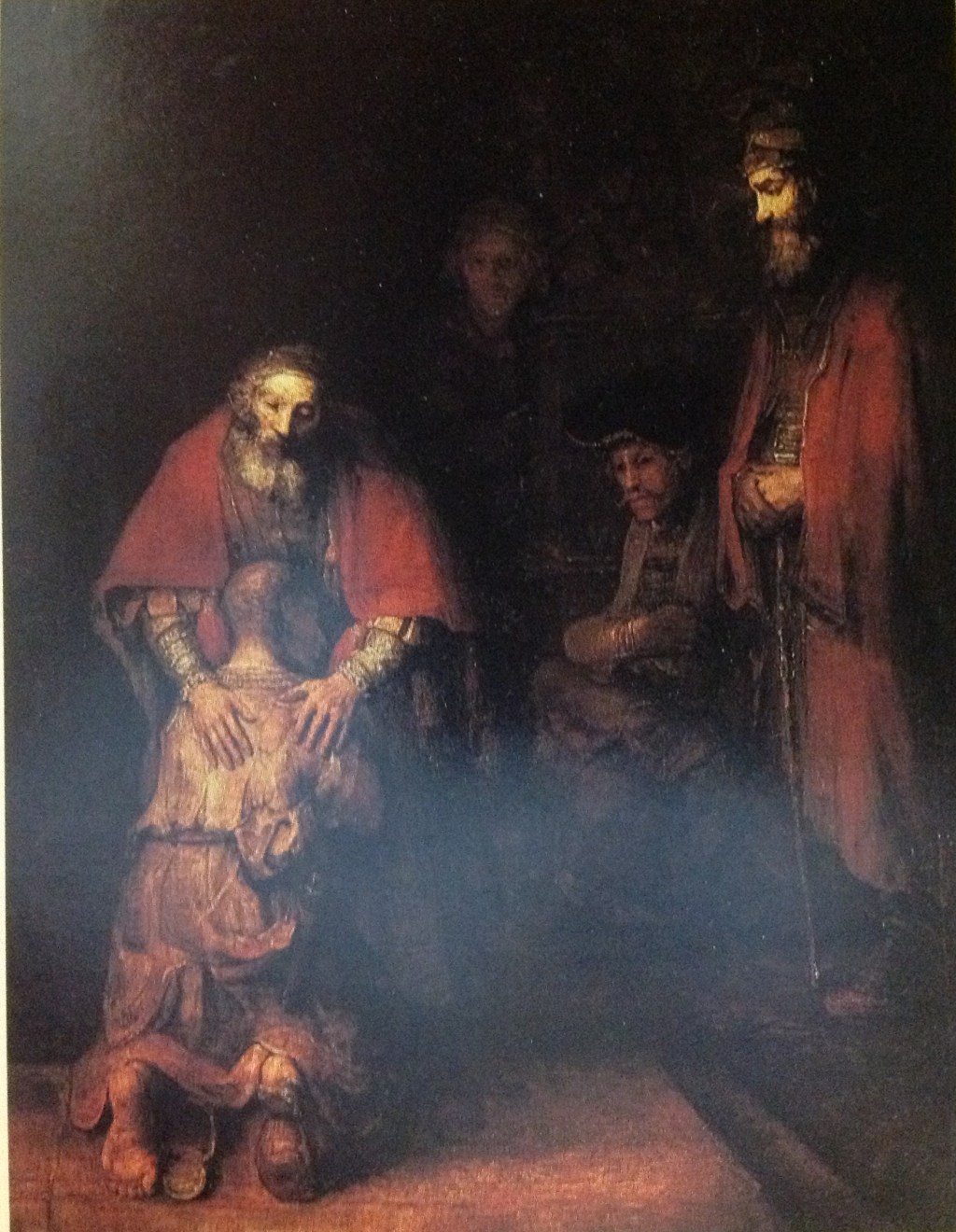
One of my favorite works of art is Rembrandt’s Return of the Prodigal Son (pictured at the top of this post). We have a framed reprint in our home displayed in the guest room – after all, it is one of Scripture’s most enduring displays of what a warm welcome looks like. The painting is truly a masterpiece on many levels; Rembrandt’s use of light and shadow in his works become an integral part of the story being conveyed. I came to a deeper appreciation of this painting when I had discovered Henri Nouwen’s book, The Return of the Prodigal Son: A Story of Homecoming, when I was in Seminary.
Nouwen was a priest, professor, and prolific author of spiritual writings from the Netherlands. His book is an inspiring reflection on Rembrandt’s representation of the parable in the light of Nouwen’s own spiritual journey. It has served me well as a useful Lectio Divina guide through Luke 15:11-32; the parable of the father with two sons. What follows is my own recent reflection on this parable, Nouwen’s book, and the painting, completed over several sessions. I will close with how this exercise linked with my own transformed recollections of my father.
Rembrandt’s use of light and shadow in his works become an integral part of the story being conveyed.
Initially, sitting with the Scripture reading, I could only marvel at the statement, “So he divided his property between them” (Luke 15:12). The younger son made his demand and without pause or hesitation the father complied. I was torn; I am a son, the youngest of three sons, and I could never have imagined going to my father with such a request, let alone my father responding in this manner. Thinking what dad’s response might have been made me laugh aloud.
I am also a father of two sons; would it have ever occurred to me to respond as this father did if one of my sons came to me with this request? For much of that first unsatisfying session I played ping pong in my head going back and forth between being son and being father; it was not going well. Then it occurred to me that I needed to slow down, center myself, and focus on what God wanted to show me here. Given the inner turmoil this stirred up, I knew I had the right passage (Is there a wrong one?) for this reflection; so that is why I decided to return to it the next day, taking a different approach.
In his book, Henri Nouwen charted the course of his spiritual journey by focusing on each of the three main characters (younger son, elder son, and father) in succession. I decided to try his approach, starting with the younger son.
Rereading the passage from this perspective, I looked closely at my own choices in life. I examined my own worldly pursuits and how I had returned (slowly) to God the Father after many years of separation and wandering, and the warm embrace of mercy and forgiveness I received upon my return. I recall vividly how that required a radical awakening of trust; for me that came via the message of Divine Mercy, the realization that “Jesus, I trust in you.” But that is a another story for a different day. This day I came to recognize the radical trust the younger son must have come to in order to return to the father; humbled, pride destroyed, driven to despair, he put his hope, his trust, in his father’s mercy. And that is exactly what he found.
I will say to him, “Father, I have sinned against heaven and before you; I am no longer worthy to be called your son; treat me as one of your hired servants.”
– Luke 15:18-19
Day three, reading aloud and listening again to the passage, this time through the lens of the elder son. I was shocked. For the first time hearing this parable I realized how closely I could relate to his perspective; the petty jealousies and resentment, the sense of entitlement, the holier than though attitude. It was frightening. I met a side of me I had apparently chosen to keep hidden, even from myself. As Nouwen astutely points out, the elder son was also lost even though he had never left home. Yet the father remained steadfast in his love of this son just as he does for the younger one, complete and unconditional; as Nouwen says, “it leaves us face to face with one of life’s hardest spiritual choices: to trust or not to trust in God’s all-forgiving love.” (Nouwen, 75) There it is again, that theme of trust that has been so consistent in God’s message to me throughout my own spiritual journey.
I came to recognize the radical trust the younger son must have come to in order to return to the father; humbled, pride destroyed, driven to despair, he put his hope, his trust, in his father’s mercy. And that is exactly what he found.
Day four brought me home to the father; the generous, loving, merciful, forgiving father. Nouwen asks a question in his book that I sat with for a while after having read the passage again; “Can I give without wanting anything in return, love without putting any conditions on my love?” (Nouwen, 128) Nouwen talks about a fatherhood of compassion, but for me, it must start with a deep humility, letting go completely of pride, ego, a need for power, control, or competition. Only then can a compassionate spirit take over, paving the way for a true ministry of presence, as the father demonstrates his full and unconditional loving presence equally to his sons.
But while he was yet at a distance, his father saw him and had compassion, and ran and embraced him and kissed him.
– Luke 15:20
As I reflect on what deeper meaning I take away from this experience, how my life has been touched and how my work as a Chaplain has been informed, the following model comes to mind. It starts with a deep and abiding trust that God is at the center of all ministries serving His purposes. Humility then moves all other agendas out of the way of expressing compassion. Compassion is needed to establish relationships built on His presence through us, which keeps us humble. This model has helped me think about God’s message, the work He has called me to, and what He is saying to me personally:

On day five, having read the passage again and sitting with it quietly, I realized how far I had come in just a few days from that inner turmoil of trying to reconcile my son versus father role to being content with just listening to the silence within me. Nouwen captured perfectly what I was experiencing: “Every time I touch that dreadful yet fruitful emptiness in myself, I know that I can welcome anyone there without condemnation and offer hope. There I am free to receive the burdens of others without any need to evaluate, categorize, or analyze. There, in that completely non-judgmental state of being, I can engender liberating trust.” (Nouwen, 133) Jesus, I trust in you.
Can I give without wanting anything in return, love without putting any conditions on my love?
– Henri Nouwen
As I shared earlier, I am certain that the Father’s Day connection with my reflection was no coincidence. Completing that exercise, I was then drawn back to Rembrandt’s painting, The Return of the Prodigal Son: Sitting with the painting, I felt drawn again to the father; his gentle features, stooped posture, welcoming arms, with his hands gently placed upon the shoulder and back, compassionately embracing the younger son. I could not help but think about my own father and my relationship with him. I am the youngest of three sons by five and eight years, my dad being nearly forty years old when I was born. The age difference with my older brothers made my teenage years feel much like that of an only child. Perhaps because he was older and tired, Dad never had much time for play or “hanging out;” I do not recall ever going outside to play “catch,” or just him and me going somewhere by ourselves to do something together. Occasionally, he would show up in the stands with my mother or one of my older brothers at one of my sporting events, but not very often. Our interactions were primarily around mealtimes and chores. Dad was always a perfectionist, with little sympathy or patience for mediocre performance. I worked hard to please him, was punished, often corporally when I did not. That said, I honestly have no regrets or pent-up resentment toward him. He was a product of the times and his own depression-era upbringing. I have been very blessed in my life and in no small part it is due to him, with the work ethic and values he instilled in me.
Dad passed away a few years back, aged one hundred. He was born on Labor Day, and he passed away on Veterans Day – fitting timing for a life-long laborer and decorated veteran of WWII, having served in both the European and Pacific theaters. Near the end, his stooped posture, wizened features, partial blindness, though still sharp mentally, concealed a broken-hearted and lonely man, ever since my mom had died several years prior – they had been married 69 years.
I look at the painting and I cannot help but see myself, at my father’s feet, seeking his approval. And as he always did, it occurred to me, he reached out with open arms, pulling me close. When I was younger, he would gently grab my ear, and say, “I love you my boy,” and then would add, “and I’m proud of you.” And all was well; I had received my inheritance.
Reflection questions:
- Thinking about the three characters in this parable, is there one that you relate to more than the others? If so, why?
- For those of you that are a parent as well as someone’s child, how do those roles inform you in empathizing with these characters?
- Feel free to share this post with a parent or a child along with your own reflection, letting them know you are thinking about them. Happy Father’s Day to all our fathers, and especially our Heavenly Father.
Scripture References
Luke 15:11-32
Note: Quotations with page number references are taken from the 1994 edition of The Return of the Prodigal Son: A Story of Homecoming by Henri J. M. Nouwen, Bantam Doubleday Dell Publishing Group, Inc.


Leave a comment