
“The one thing that bothers me the most about this is that I have so much to do, and now I’m all alone,” lamented the patient who recently fell and broke her hip, not long after her beloved husband of 40-plus years, Bernie, had passed away.
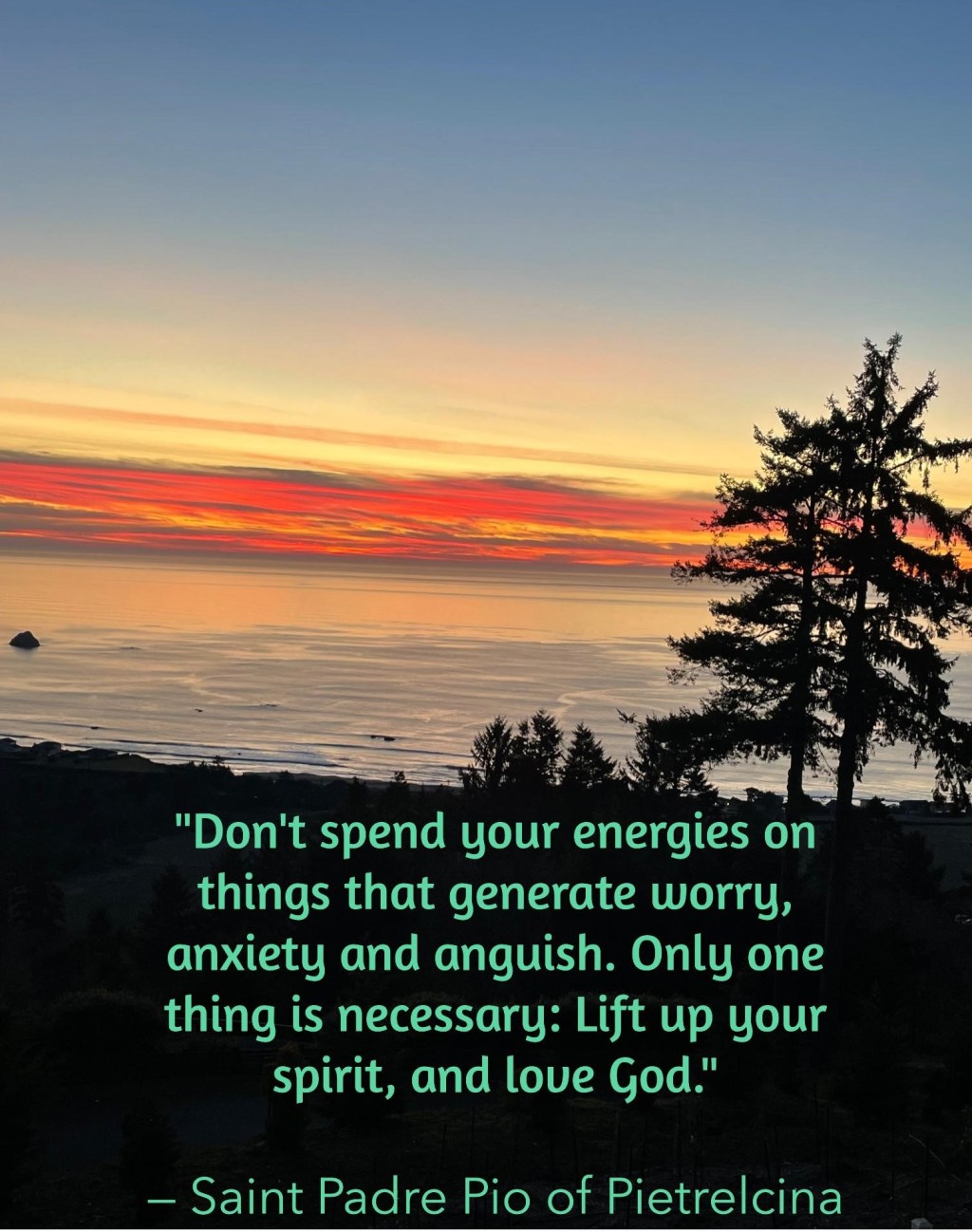
When you think about your “to do” list, sorting through the neat and nifty tasks and ideas that you believe will make your life better, remember, as St. Padre Pio said, there really is only one thing that is necessary:
“Lift up your spirit, and love God.”
This is a central theme of the Christian message, but why is it so hard to remember, let alone practice? Even for non-believers, finding and acknowledging that higher power can be the first step to a happier life.
There certainly is much in this world to cause us worry, anxiety, or anguish. I have seen it, experienced it often in my role as a hospital chaplain; a new diagnosis, the prospect of a long treatment regimen with multiple side effects, the loss of a loved one to illness or accident, a broken hip. Very often, those that have a sense of connection with something greater outside of themselves, a sense of meaning and purpose, seem to adapt better to the abrupt change in life or lifestyle. They seem to recognize that, although life as they knew it may have been dramatically altered, this is an opportunity to “lift up their spirit” and embark on a new leg of their journey to discover and get closer to that higher power.
My sense is that it is in the seeking where life happens. It serves as an important reminder that while it may feel that a part of us has died, there is still a purpose in our living, a reason for hope that there is more to the story, to our story, to be told. It is that realization of hope that lifts our spirit, elevates the soul, and ennobles the mind.
The grass withers, the flower fades, but the word of our God will stand forever.
– Isaiah 40:8
For the Christian, hope is found in Scripture and God’s promise of eternal life made possible through His son, Jesus Christ. Whatever our trials, temptations, or sufferings, we can always hold onto the hope God extends to us. It was the person and works of Jesus Christ through which God’s promise of freedom from sin and the burdens of this world became the conduit of His love and hope transforming our path of life toward fullness of joy.
I write these things to you who believe in the name of the Son of God that you may know that you have eternal life. And this is the confidence that we have toward him, that if we ask anything according to his will he hears us.
– 1 John 5:13-14
Our spirits are thus lifted through hope, and the appropriate response is love. Love of life, love of one another, love of God. Lifting oneself by the spirit out of the grief of loss, out of the pain of suffering, and taking that first step toward recovery and discovery can be spiritually healing. Seeking and connecting with that higher power, whether it is God, the universe, nature, or a conscious awareness, can provide one with a sense of peace, purpose, and direction in life – and love provides the compass and the light.
In a word, the true morality of Christianity is love. And love does admittedly run counter to self-seeking – it is an exodus out of oneself, and yet this is precisely the way in which man comes to himself.
– Joseph Ratzinger (Pope Benedict XVI) from his book, Jesus of Nazareth
Here are some thoughts to consider if/when looking for ways to find and connect with that higher power through your journey of hope:
- Empathy: We live in a world that has become painfully divided in thought and ideology; try listening to others’ experiences and opinions, and be willing to empathize with and consider their perspective.
- Mindfulness: Set aside time to be consciously present, practicing nonjudgment and compassion, with an attitude of gratitude.
- Experience nature and beauty: Connect with the beauty of the world and feel the real presence of your higher power.
- Reflect on your experience: Consider what life experiences have led you to where you are today, finding reasons to be grateful – an excellent practice for attaining peace and harmony with those experiences.
- Meditate or pray: Engage with your higher power through prayer and/or meditation.
- Spiritual literature: Explore Scripture, books, articles, and other resources on spirituality.
- Journal: Reflect on your thoughts and feelings about a higher power; regularly writing in a gratitude journal can be very therapeutic with proven health benefits.
- Engage with others and their journey: Find and attend support group meetings, book club, etc., and/or talk with a therapist.
- Service toward others: Assisting others can help put your journey into perspective, shifting your focus onto someone other than yourself.
These are just a few practical examples to help you discover and connect with that higher power that may liberate your spirit, providing hope and joy amid adversity.
So, we do not lose heart. Though our outer self is wasting away, our inner self is being renewed day by day. For this light momentary affliction is preparing for us an eternal weight of glory beyond all comparison, as we look not to the things that are seen but to the things that are unseen. For the things that are seen are transient, but the things that are unseen are eternal.
– 2 Corinthians 4:16-18
Recently, I ran into that patient with the broken hip mentioned above. She shared that she has taken up playing the ukulele and is keeping busy performing with a group of women from her church by playing at various senior centers and fund-raisers in her community: “Bernie always told me I had a voice that should be shared.” Her smile and the light of her countenance bore witness to a story of love and hope that continues to transform her path of life toward the fullness of joy.
Reflection questions:
- What is your higher power and/or what does that mean to you?
- Why do you think the connection with a higher power and/or spirituality play such an important role in the success of addiction recovery programs?
- Reflect on Ratzinger’s statement above, i.e., how love runs counter to self-seeking and yet is precisely the way we find ourselves; how/why do you think that happens?
Scripture References
Isaiah 40:8 1 John 5:13-14 2 Corinthians 4:16-18


Leave a reply to raymonddougherty Cancel reply